Lewis Hamilton Hair Transplant: Truth Behind the F1 Champion’s Hairline
Formula 1 superstar Lewis Hamilton is a global icon. He is famous for his record-breaking seven world titles. He is also famous for his bold fashion and unique style. But one topic sparks almost as much debate as his racing career. That topic is the Lewis Hamilton hair transplant. Did the champion undergo surgery to fix his receding hairline?
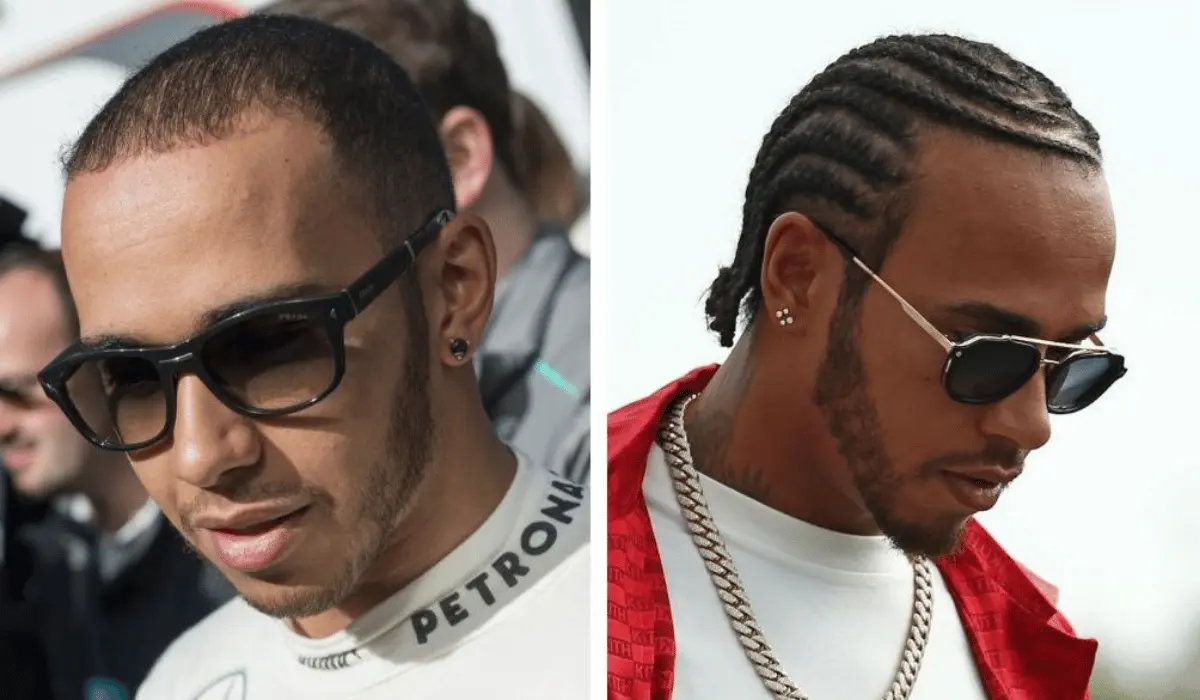
In his early career, Lewis Hamilton had visible signs of hair loss. He often wore baseball caps to hide his thinning scalp. Today, he sports thick Afro braids, twists, and dense curls. This kind of dramatic regrowth is rarely possible with just shampoo or vitamins. It usually requires medical intervention. In this guide, we will dive deep into his hair journey. We will look at the specific science of Afro hair transplants. We will also examine the costs, the risks for athletes, and the maintenance required for such a look.
The Lewis Hamilton Hair Transplant Rumors: Fact or Fiction?
Fans and experts have watched Lewis grow up on the screen. Over the years, they noticed a massive change in his hair density. The difference between his 2010 look and his 2025 look is undeniable.
The “Hotel Soap” Defense
Lewis Hamilton has publicly denied having a transplant in the past. He addressed the rumors in a candid interview. He claimed his hair loss was simply due to bad hygiene products. He stated that he used to wash his hair with cheap “hotel soap” and bath products. He claimed this damaged his hair and made it thin. According to Lewis, once he educated himself on proper hair care, his hair grew back naturally.
Why the Soap Theory Does Not Hold Up
Hair restoration experts do not agree with this explanation. Soap cannot cause male pattern baldness. Poor quality soap can certainly dry out your hair. It can cause breakage, frizz, and make hair look dull. But it does not kill the hair root. Male pattern baldness is genetic. It is caused by a hormone byproduct called DHT. DHT shrinks the hair follicle over time until it stops producing hair. No amount of conditioner can reverse this genetic process. If hotel soap caused baldness, almost every traveling businessman would be bald. The Lewis Hamilton hair transplant theory is the only medical explanation that fits the visual evidence of his hairline restoration.
Analyzing the Hamilton Family Genetics
To understand his hair loss, we must look at his family history. Hair loss is hereditary. It is passed down from both the mother’s and father’s sides.
The Father Factor
Lewis Hamilton’s father is Anthony Hamilton. Anthony has a clearly receding hairline. This is a classic sign of Androgenetic Alopecia. This is the medical term for male pattern baldness. Genetics are the strongest predictor of hair loss. If your father has significant recession, you are at a higher risk. In his 20s, Lewis showed the exact same pattern as his father. His hairline receded at the temples, creating a “V” shape. The hair on the top of his scalp also became thin.
The Norwood Scale Progression
Doctors use the Norwood Scale to measure the stages of baldness.
- Norwood 1: No hair loss.
- Norwood 2: Mild recession at the temples.
- Norwood 3: Deep recession at the temples.
- Norwood 4: Significant thinning on top and front.
In 2010, Lewis appeared to be approaching a Norwood 4. His scalp was clearly visible through his hair under the bright track lights. Today, he presents as a Norwood 1. This complete reversal is virtually impossible without a Lewis Hamilton hair transplant procedure.
The Timeline of Transformation
Let’s track the changes year by year. The photos tell the true story of his hair evolution.
2007–2009: The Rookie Years
Lewis burst onto the F1 scene with McLaren in 2007. He kept his hair very short, almost buzzed. Even then, you could see early signs of recession at the temples. The corners of his hairline were pushing back slightly. This is common for men in their early 20s, but it was a sign of things to come.
2010–2012: The Thinning Acceleration
This was a stressful period in his career. His hair loss accelerated noticeably. The recession at the temples became deep bays. The forelock (the island of hair in the center front) became isolated and thin. He wore baseball caps almost constantly during interviews and podium ceremonies. This is a common behavior for men who feel insecure about their hair loss.
2013–2015: The Recovery Phase
This is when the magic happened. Around late 2013 and early 2014, his hairline started to look straighter. The deep bays at the temples began to fill in. By 2015, the density was much higher. He stopped cutting his hair so short and began to grow it out. This timeline fits perfectly with a hair transplant. It takes about 12 months for the full results of a surgery to show. A procedure done in the winter break of 2013 would show full results by 2015.
2018–Present: The Braids Era
Now, Lewis wears long braids, cornrows, and twists. This style requires strong roots. You cannot braid thin or weak hair. The tension would pull it right out. His ability to wear tight cornrows confirms his hair is strong, healthy, and well-anchored. This level of density on a previously thinning scalp is the ultimate proof of a successful Lewis Hamilton hair transplant.
The Science of Afro Hair Transplants
Transplanting Afro-textured hair is widely considered the most difficult procedure in the hair restoration industry. It requires a master surgeon with specific experience.
The Challenge of Curved Follicles
Straight hair grows straight down into the skin like a nail. Afro hair is different. It curls above the skin, but crucially, it also curls under the skin. The root often has a “C” shape or a hook shape.
Standard extraction tools are straight. If a surgeon tries to punch out a curved Afro hair with a straight tool, they will cut the root in half. This is called transection. A transected follicle is dead. It will not grow if you plant it. In the past, many clinics refused to treat Afro hair because they had high failure rates.
Specialized Tools for Afro Hair
To perform a successful Lewis Hamilton hair transplant, the surgeon likely used special technology.
- Curved Punches: These tools are designed to follow the curve of the hair beneath the skin.
- Blunt Punches: These tools push the skin away rather than cutting it sharply. This protects the follicle from damage.
- Wider Diameter: Afro hair follicles are often thicker and occupy more space. A slightly wider punch ensures the whole graft is taken safely.
FUE vs. FUT: Which Method Did He Use?
There are two main ways to extract hair. Lewis likely chose the modern, less invasive option.
FUT (Follicular Unit Transplantation)
This is the traditional “strip” method. The surgeon cuts a strip of skin from the back of the head. They then dissect the hairs under a microscope.
- Pros: Lower transection rate for Afro hair because the surgeon can see the roots clearly.
- Cons: Leaves a long linear scar on the back of the head.Lewis often wears his hair short on the sides or in fades. A strip scar would be visible. It is highly unlikely he chose this method.
FUE (Follicular Unit Extraction)
This is the individual extraction method. The surgeon takes hairs one by one from the donor area.
- Pros: No linear scar. Only tiny dot scars that are hard to see. Quick recovery.
- Cons: Higher risk of damaging Afro roots if the surgeon is not skilled. Takes longer to perform.Given his wealth and need for discretion, Lewis likely chose FUE. He would have hired a top specialist who can perform FUE on Afro hair with low transection rates. This allows him to have fades and short cuts without showing a tell-tale scar.
DHI (Direct Hair Implantation)
DHI is a technique for placing the hair into the balding area. The surgeon uses a specialized pen called a Choi Implanter. This pen protects the hair graft and allows the surgeon to control the angle and depth perfectly.
For Afro hair, the angle is critical. The hair must exit the scalp at a natural curl angle. If the angle is wrong, the hair will look frizzy and unmanageable. DHI is the best method for high density and natural angles. It is highly probable the Lewis Hamilton hair transplant involved DHI technology.
Comparison of Hair Transplant Techniques for Afro Hair
| Feature | FUE (Follicular Unit Extraction) | DHI (Direct Hair Implantation) | FUT (Strip Method) |
| Scarring | Tiny dots (invisible with short hair) | Tiny dots (invisible with short hair) | Linear scar (visible with short hair) |
| Recovery Time | Fast (5-7 days) | Fast (5-7 days) | Slow (10-14 days) |
| Afro Suitability | High (with expert surgeon) | High (best for angles) | High (easiest extraction) |
| Cost | High | Very High | Moderate |
| Lewis’s Likely Choice | Yes | Yes (Combined with FUE) | No |
F1 Helmets and Hair Loss: A Unique Danger
Lewis Hamilton faces a risk that most men do not. He wears a tight, fireproof racing helmet for hours at a time. This creates a hostile environment for hair health.
Traction Alopecia from Helmets
Helmets can cause a condition called traction alopecia. This is hair loss caused by pulling and friction.
- Friction: The helmet lining rubs against the hairline. This happens every time he puts it on or takes it off. This constant rubbing can break fragile hairs.
- Pressure: The helmet fits very tightly for safety. This pressure can reduce blood flow to the scalp capillaries.
- Sweat and Bacteria: F1 drivers sweat significantly during a race. Sweat builds up inside the helmet, creating a warm and damp environment. This can lead to scalp inflammation and folliculitis.
Protecting the Investment
After a Lewis Hamilton hair transplant, the new grafts are very fragile. They take about 10 days to anchor securely. A helmet could easily rip them out. Lewis likely scheduled his surgery during the F1 winter break. This break usually runs from December to February. This gives him about 3 months of recovery time without wearing a helmet. He also likely wears a silk or satin balaclava. Silk reduces friction and allows the helmet to slide on without grabbing the hair. This is a crucial step for any athlete with a hair transplant.
Braids and Transplants: The Safety Rules
We see Lewis with intricate braids often. But braids can be dangerous for transplanted hair.
The Risk of Tight Braids
Transplanted hair is permanent, but it is not invincible. The skin around it is still skin. Tight braids create tension. This pulls on the roots. Over time, this can cause the hair to fall out again. This is called secondary traction alopecia. It is very common in the Afro community. Braids and cornrows look great, but they must be done correctly.
When Can You Braid After a Transplant?
You cannot braid immediately after surgery. The scalp needs time to heal fully.
- 0 to 6 Months: No braiding. The hair should be worn loose or in a loose Afro.
- 6 to 12 Months: Loose twists are allowed. No tight pulling at the edges.
- 12 Months Plus: Braids are safe if they are not too tight.Lewis waited several years before sporting his current tight braided styles. This patience ensured his transplant was fully mature and strong enough to handle the tension.
Medical Management: Keeping the Hair
Surgery only fills the bald spots. It does not stop the native hair from falling out.
Finasteride and Minoxidil
If Lewis did not take medication, his old hair would continue to recede behind the transplant. He would be left with a strange pattern of hair. Most experts agree he likely uses Finasteride or Minoxidil.
- Finasteride: This is a pill that blocks DHT. It stops the genetic signal for hair loss.
- Minoxidil: This is a topical liquid. It stimulates blood flow to the follicles. It makes hair thicker and stronger.Using these medications helps maintain the density behind the hairline. It protects the investment of the surgery.
Is Finasteride Allowed in F1?
Yes. Finasteride was once a banned substance in sports because it could mask steroid use. However, the World Anti-Doping Agency (WADA) removed it from the banned list in 2009. Lewis Hamilton can take this medication legally without violating any doping rules. This clears the way for him to maintain his Lewis Hamilton hair transplant results safely.
The Cost of a Championship Hairline
Lewis Hamilton is one of the highest-paid athletes in history. He did not look for a bargain. He looked for the best.
The “Celebrity” Premium
A standard Afro hair transplant is already more expensive than a regular one. It requires more time and skill.
- Average UK Cost: £6,000 to £10,000.
- Average Turkey Cost: $2,500 to $4,000.
- Celebrity Specialist Cost: $20,000 to $50,000.
Lewis likely paid the top tier price. He would require a private clinic or a surgeon who visits him. He would pay for absolute discretion. The procedure for Afro hair takes longer. A session might last 10 hours or more. The surgeon must work slowly to avoid damaging the curved roots. This time and expertise justify the high cost.
Celebrity Case Studies: You Are Not Alone
Lewis Hamilton is part of a growing trend. Many black male celebrities are fixing their hairlines and speaking about it.
Tyga
The rapper Tyga is very open about his procedure. He even shared his surgeon’s contact information. He went from a receding hairline to a very straight and dense look. His results are often compared to the Lewis Hamilton hair transplant quality in terms of density and naturalness.
LeBron James
LeBron James tried to hide his hair loss for years. He used headbands and hair fibers. He eventually had a procedure to restore his hairline. His look is more conservative than Lewis’s, keeping a mature hairline shape that suits his age.
Jamie Foxx
Jamie Foxx also improved his hairline. He had a very sharp and defined line created. This frames his face and makes him look younger. These examples show that the stigma is fading. Men are taking control of their appearance.
Expert Insights on Lewis Hamilton’s Results
We analyzed his photos with the eye of a hair restoration expert. Here is what stands out about his specific results.
The Soft Hairline Design
A natural Afro hairline is not a straight ruler line. It has irregularities. It has softer, thinner hairs at the very front. Lewis’s surgeon did an excellent job here. They placed single-hair grafts at the front in a zigzag pattern. This mimics nature. It prevents the “doll hair” look that was common in the past.
Temporal Peak Restoration
The “temporal peaks” are the sharp points of hair on the sides of the forehead. In his 20s, Lewis lost these. Now they are back. Restoring these points is very artistic. It frames the face perfectly. It balances the forehead width. This detail proves he went to a master surgeon.
Density Management
Afro hair has a unique advantage. The curl creates a “roofing” effect. It covers more scalp than straight hair. This means you need fewer grafts to look full. Lewis’s surgeon used this to their advantage. They packed the grafts densely to support his braided styles, ensuring no scalp shows through even when the hair is pulled tight.
FAQs: Lewis Hamilton Hair Transplant
Here are the most common questions about his hair journey.
1. Did Lewis Hamilton admit to a hair transplant?
No. He has publicly denied it. He claims his hair regrowth is due to better hair care and stopping the use of hotel soap. However, medical experts state that soap cannot cause male pattern baldness and his regrowth is consistent with a transplant.
2. How much does a Lewis Hamilton hair transplant cost?
It is estimated to cost between $30,000 and $50,000. This price includes the fee for a top-tier specialist, the complexity of Afro hair extraction, and VIP privacy services.
3. Is it safe to wear a helmet after a hair transplant?
Yes, but you must wait. Patients should wait at least 3 to 4 weeks before wearing a tight helmet. This allows the grafts to anchor securely. Wearing a helmet too soon can dislodge the new hair.
4. Why is Afro hair harder to transplant?
Afro hair roots are curved under the skin. Standard straight tools can cut the root during extraction. Specialized curved punches and high surgical skill are required to extract the hair safely without killing it.
5. Does Lewis Hamilton take hair loss medication?
It is highly likely. To maintain the hair behind the transplant, most patients take Finasteride or use Minoxidil. Finasteride is allowed in Formula 1 and is not considered a performance-enhancing drug.
6. Can you braid transplanted hair?
Yes, but you should wait at least 12 months. The hair needs to be fully mature and the scalp fully healed. The braids should not be too tight to avoid causing new hair loss from tension.
7. What Norwood Scale was Lewis Hamilton before surgery?
He appeared to be a Norwood Scale 4. He had deep recession at the temples and significant thinning on the top of his head. He is now a Norwood Scale 1.
Conclusion
The Lewis Hamilton hair transplant story is one of the most successful image transformations in sports. He went from hiding his thinning hair under caps to expressing himself with bold, confident hairstyles. While he credits “better soap” for his locks, the science tells a different story. The density, the hairline shape, and the timeline all point to expert surgical restoration.
His journey proves that Afro hair can be transplanted successfully. It breaks the stigma that hair transplants are only for straight hair. It shows that with the right resources and the right doctor, you can turn back the clock. Lewis Hamilton is a champion on the track. With his new hairline, he is also a champion of style. He looks younger, fresher, and more confident than ever. And in the high-speed world of F1, confidence is everything.